Pages

Wednesday, 27 February 2019

The World's Best Short-Short Story Contest. Deadline: March 15

General Guidelines

There are two ways to submit! You may either send your typed entry via snail mail to the address listed below, OR take advantage of our online contest submission option (please note all submissions are subject to an entry fee of $16). For mailed submissions, make checks or money orders out to: The Southeast Review. Electronic and postmark deadline: March 15, 2019.

Friends and current or former students of the judge and those who have been affiliated with Florida State University within the last five years are ineligible.

For mailed submissions, please do not send an SASE. Winners will be announced on the website in June. All contestants will receive the issue in which the winning submissions appear.

Only previously unpublished work will be considered. If you want to withdraw any individual pieces from consideration (in the case of our poetry or short-short story contests), please log in to Submittable and add a note to your submission telling us which pieces you wish to withdraw. In the case of mailed submissions, please contact the appropriate genre editor.

The World's Best Short-Short Story Contest

In 1986, Jerome Stern, the then-director of Florida State University’s Creative Writing Program and renowned author of Making Shapely Fiction among other books, founded this contest to celebrate what he called “micro fiction” (submissions at that time were required to be under 250 words, and the winner received a crate of oranges as well as a check). Stern passed away from cancer in 1996 and though the guidelines and prize have changed since then, we are grateful to have a modern master of the short-short story judge the entries annually, and continue to hold the contest in memory of Stern.

Send up to three short-short stories per submission, accompanied by a $16 reading fee for mailed or online submissions. Each short-short story should be no more than 500 words. Include your name, contact information (email address preferred), and the title of each of your short-short stories in a very brief cover letter. Do not include personal identification information on the short-shorts themselves. One winner (awarded $500) and up to five finalists will be announced in Summer 2019 and will appear in Volume 38.1 (Spring 2020). For mailed submissions, label envelope: WBSSSC. Do not address your submission directly to the judge.

Address

The Southeast Review

Department of English

Florida State University

Tallahassee, FL 32306
Free Event: Iain Archer, Lucy Caldwell, and Lisa McGee, I'm chairing. March 5

The three Seamus Heaney Centre Fellows for 2019, Iain Archer, Lucy Caldwell, and Lisa McGee will reflect on their diverse creative practices, in conversation with writer Paul McVeigh. 
This is the closing event for the Writing Through Conflict symposium, hosted by the School of AEL and the Seamus Heaney Centre at Queen's, in partnership with National Museums NI.
Iain Archer is a Grammy nominated musician from Bangor, who has written and produced for artists such as Snow Patrol, Jake Bugg, Liam Gallagher and James Bay. He has received two Ivor Novello Awards and a third nomination. As well as his critically acclaimed solo career, Iain is a member of the band Tired Pony.
Lucy Caldwell is an award-winning Belfast-born author of three novels, several stage plays and radio dramas, and a collection of short stories. She is the editor of Being Various: New Irish Short Stories (Faber, 2019). 
Lisa McGee is a stage and screen writer from Derry, she studied Drama at Queen's University Belfast. Her plays include The Heights, Nineteen Ninety Two, and Girls and Dolls, and Jump, which has been adapted into a film. Lisa is the acclaimed writer and creator behind the hit Channel 4 sitcom’s London Irish and Derry Girls.

Date And Time

Monday, 25 February 2019

PAID: True Story seeks Creative Nonfiction

True Story

Accepted Year-Round
The Creative Nonfiction Foundation is pleased to announce that, with support from the National Endowment for the Arts, we’ve started a new monthly magazine. Each issue of True Story will features one exceptional work of creative nonfiction, and is distributed in print and digitally (though not available online).
Submissions should be between 5,000 and 10,000 words long, on any subject, in any style. Surprise us! The only rules are that all work submitted must be nonfiction and original to the author, and we will not consider previously published work.
We’ll pay $300 on publication and give you 10 free copies of “your” issue.
We’ll do our best to respond to submissions within three months. We can’t promise to consider work submitted for True Story for any of CNF’s other projects or publications—but we reserve the right to do so.
Guidelines: Essays must be previously unpublished and no longer than 10,000 words. Multiple submissions are welcome, as are entries from outside the United States. 
Submit online:
There is a $3 convenience fee to submit online.
Or, we're offering a submit-and-subscribe rate: $18 covers your submission fee and gets you a print subscription to a year of True Story (price for US mailing addresses, international prices vary). The convenience fee is waived for current subscribers to True Story.

A Phenomenal Woman - Unpublished Interview with Maya Angelou

Playboy's (yes, you heard me) Archive unearthed a priceless treasure: an unpublished Interview with Maya Angelou

Friday, 22 February 2019

I'm Attending Maria Edgeworth Festival May 11th

The Maria Edgeworth Festival and society produce events celebrating the legacy of MariaEdgeworth - this is very exciting to me as I read Castle Rackrent at university. They also promote and celebrate the rich cultural and literary heritage of County Longford. This year is the 400th anniversary of the arrival of her family to Edgeworthstown. I'm delighted to be judging their short story competition(and giving out the prize at the fest), teaching a class and reading from my work.

Here's my events...

11th May 2019

11.00 a.m. - 1.00 p.m. Short Story Workshop with Paul McVeigh (click to book)
Venue: The Old Schoolhouse, Edgeworthstown

8.00 p.m. Anniversary Celebration (click to book)
Venue: The Manor Church, Edgeworthstown
Poetry and Short Story Readings, featuring Nuala O’Connor and Paul McVeigh
Story & Song with Aidan O’Hara
Music and song with Eleanor Quaine and Comhaltas Ceoltoiri Eireann.
Presentation of prizes to competition winners.
Refreshments served

Check out the rest of the festival here... 


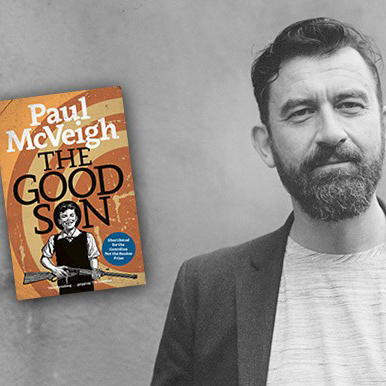
“I devoured it in a day, but I’ve thought about it for many, many more. ”
Bailey’s Prize-winnerLisa McInerney
“A triumph of storytelling. An absolute gem.”
Donal Ryan

Tuesday, 19 February 2019

Free Entry: Limnisa Short Story Competition. Deadline: March 30

Limnisa short story competition 2019 - Win a writing holiday
Take part in our yearly short story competition and win a writing holiday in Greece. Many have gone before you!

We are looking for stories in English of up to 1500 words inspired by the photograph on this page; you're next!

Entries must be the author’s original, unpublished work of fiction in English of 1500 words or less and submitted by email to entries@limnisa.com before 23.59hrs on Sunday MARCH 30, 2019.

Subject is free and inspired by the picture below: You're NEXT. We're looking for writing with spark and conviction.

Read the winning stories of last year to get an impression of what we like!
Participation is free. Just like us on social media or spread the news about our contest.


The Good Journal seeks British Writers of Colour. Deadline: March 15

Submissions for The Good Journal are now open!

We're excited to open the submission window for the fourth issue of The Good Journal.
Issue 4 will be guest edited by Diana Evans
The submission window will be for three weeks between 15th February 2018 and 15th March 2019. Anything sent in after then won’t be considered. Submissions close at 11.59pm on Friday 15th March 2019

Please read the guidelines carefully then fill in the form at the end.

If you are a publisher or agent who wants information about submitting writers you publish or represent please email thegoodjournaluk@gmail.com

Guidelines
Who Are You?

We’re looking for work by British writers of colour. Either you are a British citizen, born her or naturalised, or you are a resident of Britain. That makes you eligible. You have to be over 18. In terms of your publishing history, we’re not fussed. We’re only concerned about the work. So, if you’ve never been published before, ever; or if you have a blog; or if you had an essay published online or in a university journal; or if you’ve had short stories published in anthologies; or if you’ve had your first novel published; or if you’ve won major prizes and have had seventeen books published – all we’re interested in is your submission and it being awesome. If you’re usually known for another medium eg film or dance or music, if you have a story you have to tell and it needs to be written, that’s cool too. Basically, we’re looking for all of you. But most of all, we particularly encourage the yous who have never been published before, or are starting out, or have been writing for years but have had no luck getting published – you especially, you… you send your work in.

What exactly is a writer of colour? How do I know if I/my author is one? Person of colour is a term used to describe any person who is not white. The term encompasses all non-white groups, emphasising common experiences of racism. It typically refers to individuals of non-Caucasian heritage.

What Are We Looking For?

First and foremost, we’re looking for finished work.

Beyond that we’re looking for essays, articles, features, creative non-fiction, fiction, short stories, poetry, comics, photo essays, extracts of novels. If you’ve got any of those, go for it. It doesn’t have to be on a particular topic. It just has to be good. How do we define good? Well, it’s just good innit.

Length & practicalities

For prose – anywhere from 1,000 words to 3,500 words.
For poems – maximum 3. We will pick a maximum of one per poet.
For comics or photo essays – maximum 2 pages.

And we only want one submission per person so we really do want you to submit your absolute best work.

A word on those novel extracts – whilst we're keen to publish novel extracts we need to make sure that what we're publishing is both original and not going to impinge on a publisher's usage and rights. So if it’s for a novel that’s going to be published then we can’t take it unless it's submitted by the publisher. If it’s already been published, we can’t take it. If it gets accepted and you get a publishing deal before the issue is out, we can’t take it, unless the publisher is happy with this.

A word on those other things – this has to be the first place your piece has been published, both in print and digitally. You’ll retain the copyright on the work but we’ll be signing for the right to publish that work for the first time.

So, don’t think there’s any one thing we’re looking for. We’re just looking for good writing first and foremost.

How Do We Want It Submitted?

This bit’s important and we’re gonna be ruthless about it. Mostly because we’ll be reading a lot of these on screens and ereaders and it can get confusing quickly. So here’s some helpful bullet points and there's more detail below on poetry, comics & photo essays:

Save the filename as YOUR NAME TITLE OF PIECE. Not as ‘essay’ or 'short story'

Arial. 12 point. Double spaced.

Save either as a .doc, a .docx or a .pdf. Nothing else. N-O-T-H-I-N-G

Don’t share a OneDrive, Dropbox or Google Doc with us. We need the saved file.

Your name and the title of the piece should be on the front page. Don’t put it in the header or footer cos ereaders sometimes does horrible things with these.

It has to be submitted through the portal. Not emailed directly to us. Even if you know us or have chatted to us informally or we’ve tweeted or whatever. Submit through the portal. It has to all be in one place.

Finished work only. I don’t mind if all our entries come in on the last day. Just so long as it’s all finished.

Check you’ve done all these things before submitting. Because if you haven’t, we won’t read it. Sorry.

If you are sending POETRY, this is how we would like them to be submitted:
We will accept a maximum of three poems. The poems can be any length. The poems must come in one single document. Each new poem must start on a brand new page in the document. It's important you use Arial 12 point as the font and size. However, if you have specific formatting requirements for the poems, then they don't need to be double spaced. It's important they be formated as intended. When saving the file name, please call it YOUR NAME POEMS. EG William Shakespeare Poems. Nothing else. Your name, followed by the word Poems.

If you are sending COMICS, please format them to A4 full colour. If possible, the lowest possible file size would be great. So under 2mb. If we like what we see, we will ask to see something higher resolution. All the final formatting, including correct sizing and bleed will come if we select you for the magazine. It's important we gauge the work first.

If you are sending PHOTO ESSAYS, please embed text and photo into a document and pdf it. Again, we'd appreciate the lowest possible file size for the moment, so under 2mb. If we like what we see, we'll ask to see something higher resolution.

Obviously your work will come with a degree of specific requirements that sit outside of the submission guidelines we've laid out. We've tried to be as accessible and general as possible. However, if you feel like you have concerns about how to deliver the work and whether you're formatting it correctly, please drop us an email at thegoodjournaluk@gmail.com

Don't tweet us or Facebook us specific submission questions. We might miss them.

What If I Don’t Get Selected For This Issue?

You can totally submit something new for issue 3. If you don’t get selected for this one, it just means it wasn’t the right piece for the issue. But totally do keep trying. You can only submit one piece once. If it gets rejected, you can’t resend it for the next issue submission period. In special cases, you may be selected for a future issue but not the first one. We don’t think we’ll be able to give individual feedback sadly. Not because we don’t want to. But because we’re a small operation and our time is very stretched!


What If I Get Selected For This Issue?

Congratulations! You’ll get an email from us, letting you know. At which point, take the rest of the day off! How it’ll work is, we’ll let people know in late January/early February. We’ll then deliver notes and probably a very tight turnaround to get a version back to us. It’ll then be typeset and we’ll then send you back a copy of those pages to proofread before it goes to print. Don’t worry. We will also be proofreading. It’s not just down to you. Once we have the final version we are both happy with, you can invoice.

Is It Paid?

Yes. You get paid £150 for a story or essay or £50 for a poem. Which isn’t much, we know. But we’re operating on a tiny budget and it’s the best we can offer!

RTÉ Radio 1 Short Story Competition. Deadline: May 10

RTÉ Radio 1 has today invited short story submissions for one of Ireland’s longest established and most significant literary prizes, the RTÉ Radio 1 Short Story Competition in honour of Francis MacManus.
Judging the entries this year are bestselling author Liz Nugent, RTÉ Arts and Media correspondent and author Sinead Crowley, and Declan Meade of The Stinging Fly. Writers will have three months to get their submissions in, with a closing date of Friday May 10th.

The RTÉ Radio 1 Short Story Competition has been a critically important launch pad for new and emerging writers since its inception in 1986, with a wide ranging appeal including young aspiring authors in Ireland.

About the Competition

The RTÉ Radio 1 Short Story Competition has been a critically important launch pad for new and emerging writers since its inception in 1986, with a wide ranging appeal including young aspiring authors in Ireland.
A competition for original short stories for radio was first established in 1986 in honour of the RTÉ Radio head of features, and acclaimed novelist, Francis MacManus (1909-1965). Since then, it has been a source of encouragement, support and recognition for new, emerging writers as well as established names. Past winners have gone on to receive national and international acclaim, including Claire Keegan, Molly McCloskey, Ivy Bannister, Anthony Glavin and Nuala O’Connor, and many more. 
Every year, the winning and shortlisted stories are produced and broadcast on RTÉ Radio 1 in a season of new writing, read by leading actors, who in recent years have included Peter Hanly, Emmet Kirwan, Cathy Belton, Ingrid Craigie, Denis Conway, Andrew Bennett, Kathy-Rose O'Brien, and many more. 
This year, the full shortlist of 10 stories will be broadcast in the autumn, and will be available for download as podcasts. And for the 2018 competition, all three prizewinning stories will be available to read on thejournal.ie following broadcast.

SLS Contests: Essays, First Chapter, Flash Fiction, Poetry & Short Stories. Deadline: Feb 28

Contests

The SLS 2019 Literary Contest is bigger than ever.

We are thrilled to offer new categories and exciting new publication opportunities in this year’s contest!
Read on for details, prize descriptions, and submission guidelines.
In addition to the Fiction and Poetry categories with our friends at Fence Magazine, we are also launching a First Chapter contest in collaboration with Graywolf Press, and an Essay and Flash Fiction contest, in collaboration with Scoundrel Time.

Prizes

for Fiction & Poetry:
1st place in each category—free airfare, tuition, & accommodations for a 2019 SLS program of your choice, and publication in Fence Magazine.
2nd place in each category—a full tuition waiver for a 2019 SLS program of your choice.
3rd place in each category—a 75% tuition discount for a 2019 SLS program of your choice.

For the NEW First Chapter contest:
1st place winner will receive a full tuition waiver for a 2019 SLS program, and online publication of the winning chapter with Graywolf Press.

For the NEW Essay and Flash Fiction contests:
1st place in each category will receive a full tuition waiver for a 2019 SLS program, and online publication with Scoundrel Time.
Additionally, a number of fellowships will be offered to participants across all categories based on the quality of their submissions.

2019 Contest Guidelines

General Guidelines
  • Each submission must be accompanied by a $17 USD submission fee.
  • You may submit more than once (and in multiple categories) so long as each submission is separate, and accompanied by the $17 USD fee.
  • You may attach your work as a Word or PDF document.
  • Your name should not appear anywhere on the manuscript itself, please.
  • The deadline to submit is February 28th, 2019, at 11:59 PM.

Fiction & Poetry Contest, with Fence Magazine
  • Fiction submissions must be under 25 pages
  • Poetry submissions may be up to 10 pages, with maximum one poem per page.

First Chapter Contest, with Graywolf Press
  • The submitted work must be unpublished.
  • Submissions should be a single chapter or excerpt from a chapter; not multiple shorter excerpts. It should be the first chapter of the work.
  • Submissions must not exceed 25 pages.
  • If you choose to include a brief passage to contextualize the reader (which is by no means required), this passage is included in the page limit.

Essay and Flash Fiction Contest, with Scoundrel Time
  • Submit a personal essay/piece of creative nonfiction  OR a piece of Flash Fiction addressing any topic related to the general theme of threats against democracy and human rights, whether that applies to groups, cultures, individuals, or landscapes.
  • Essays should not exceed 4,000 words.
  • Flash Fiction submissions should not exceed 1,200 words.

Submit your best work before February 28th, 2019!

Click here to submit!

Wednesday, 13 February 2019

London Book Fair: Talking with Indonesian writers. March 13

I’ll be appearing at the London Book Fair Wednesday, March 13th at the invitation of The British Council. I’m excited by the topic of the conversation and to talk to some Indonesian writers after my trip there to The George Town Literature Festival in 2018. Here are the details.
Taboo
Laksmi Pamuntjak, Norman Erikson Pasaribu and Paul McVeigh; chaired by Phillip Kim
16.00-17.00, Cross Cultural Hub, Olympia
Indonesian writing today is becoming more bold, more inventive, and more determined to say the unsayable. How, through literary experiments, style and themes, are Indonesia’s writers tackling taboos and redefining norms? Laksmi Pamuntjak, author of The Question of Red – which counters the official government history of 1965; Norman Erikson Pasaribu, whose poems shine light on queer Indonesian life in the midst of erasure and oppression today; alongside Paul McVeigh whose writing touches on the complex layers of political oppression, violence and sexuality; discuss their personal reasons for writing on their chosen subjects, and the need to explore, and unsettle, the dominant narratives.
CroppedImage1396770-11.04.18-British-council-266

Tuesday, 12 February 2019

Writers' HQ Flash Quarterly Competition. Deadline: March 31

Writers' HQ Flash Quarterly Competition

Writers! We want your words! So send 500 of your best to our new quarterly flash fiction competition. It's free to enter, open-themed, with no restrictions on genre or style. PLUS win yourself up to 12 months Writers' HQ membership and get access to over £1000's worth of online creative writing courses as well as UK one-day writing retreats. 


Deadline: 31st March
Word limit: 500 words
Entry fee: FREE! (But optional donations to our bursary fund are welcomed)
Prizes: 
  • 1st place: 12 months Writers' HQ membership + 3 one-day writing retreats
  • 2nd place: 6 months Writers' HQ membership + 3 one-day writing retreats
  • 3rd place: 3 months Writers' HQ membership + 3 one-day writing retreats
Find the full guidelines (for the love of all that's shiny, please read the guidelines) and entry form here >> https://writershq.co.uk/whq-flash-quarterly/ 

Monday, 11 February 2019

The Moth Short Story Prize. Deadline: June 30

The Moth Short Story Prize 2019

The Moth Short Story Prize is an important date on the literary calendar. Every year, a single judge is asked to choose three winning stories to feature in the autumn issue of The Moth.

Previous judges include Kevin Barry, Belinda McKeon, John Boyne, Donal Ryan, Martina Evans and Mike McCormack.

This year’s judge is Kid de Waal, who worked for fifteen years in criminal and family law and was a magistrate for several years before becoming a full-time writer. Her writing has received numerous awards, including the Bridport Flash Fiction Prize 2014 and 2015 and the Kerry Group Irish Novel of the Year and has been shortlisted for the Costa First Book Award, the Desmond Elliott Prize and the British Books Awards Debut Novel of the Year. 1st prize   €3,000
2nd prize
 week-long writing retreat at Circle of Misse in France plus €250 travel stipend
3rd prize  €1,000

The Prize is open to anyone (over 16) as long as the work is original and previously unpublished. There is a word limit of 5,000. The entry fee is €15 per story. Closing 30 June 2019.
LINKS: 
IN SHORT: 
1stprize €3,000, 2ndprize a week-long writing retreat at Circle of Misse in France plus €250 travel stipend, 3rdprize €1,000. The Moth Short Story Prize is open to anyone (over 16) as long as their story is previously unpublished. The word limit is 5,000 and there is an entry fee of €15 per story. This year’s judge is award-winning story writer and novelist Kit de Waal. Closing 30 June 2019. See www.themothmagazine.comfor details. 

I'm Judging - Maria Edgeworth Poetry and Short Story Competition. Deadline: March 8

I'm judging the short story comp...

Competition Rules:
  1. Entry Fee must accompany all entries.
  2. All entries must be the original work of the entrant and must
    not have been published, accepted for publication, broadcast or honoured by the closing dates for entries.
  3. All entries to be clearly written or typed on one side of the
    paper only.
  4. Name, address and or
    email/phone number to go on a
    separate attached sheet.
  5. The decision of the judges shall
    be final.
  6. Poems limited to 40 lines.
  7. Short Stories limited to 2000
    words.
    Closing Date for entries 8th March 2019

    For more info... 

Friday, 8 February 2019

Granta seeks Submissions. Deadline: Feb 21

From Nobel laureates to debut novelists, international translations to investigative journalism, each themed issue of Granta turns the attention of the world’s best writers on to one aspect of the way we live now. Granta does not have a political or literary manifesto, but it does have a belief in the power and urgency of the story and its supreme ability to describe, illuminate and make real.
Granta magazine was founded in 1889 by students at Cambridge University as The Granta, a periodical of student politics, badinage and literary enterprise, named after the river that runs through the town. In this original incarnation it published the work of writers like A.A. Milne, Michael Frayn, Stevie Smith, Ted Hughes and Sylvia Plath.
In 1979, Bill Buford transformed Granta from a student publication to the literary quarterly it remains today. Granta Books came ten years later, quickly becoming one of the most independent-minded and prestigious literary publishers in the UK.
Granta’s Best of Young issues, released decade by decade, introduce the most important voices of each generation – in Britain, America, Brazil and Spain – and have been defining the contours of the literary landscape since 1983. As the Observer writes: ‘In its blend of memoirs and photojournalism, and in its championing of contemporary realist fiction, Granta has its face pressed firmly against the window, determined to witness the world.’

When we moved from a paper system to an electronic one, the level of submissions to Granta increased exponentially. After long discussions, we have decided to trial a service fee of £3/$4, equivalent to printing and postage, for prose submissions only. We will not be charging for poetry or art and photography submissions.  

Please follow the instructions below if you wish to submit.

We look forward to reading your work! 


Guidelines

We will be open for non-fiction and fiction submissions during the following periods:
  
21 January until 21 February 2019
28 April until 28 May 2019

Due to the unprecedented number of poetry submissions received in October 2018, we will not be opening again for poetry until 28 April 2019. Thank you for your understanding. 

Submissions can be made from 10 a.m. GMT on the opening day until midnight GMT on the closing day. 
We remain open to submissions of photography and art year-round. 

Please submit only one complete story or essay, or up to three poems at a time. Multiple submissions will not be read. Fiction, non-fiction, poetry and art will be considered for both our print and online editions, unless you specifically state otherwise in your cover letter. 
We only publish original material, i.e. first-ever publication. We cannot run a piece that has already appeared on the web or elsewhere in print. We can, however, publish an original translation if the work has previously appeared in another language. We have no set maximum length or minimum length, though most of our submissions are between 3,000-6,000 words.
Please include a cover letter stating where your work has been published before, if relevant. Please do not submit book manuscripts, academic essays or reviews. Please only submit work written in English. Please use double-spacing. 
Please note that we are not in a position to comment on your work. We receive a significant number of submissions every day, many of which may be unsuitable for Granta, however well written.
We encourage to all who submit that they read recent issues of Granta to familiarise themselves with material the magazine has published. Subscriptions are available here.

Return to the Granta website here


Frequently Asked Questions

How soon can I expect to hear about my submission?
We aim to respond to all submissions within six months of receipt.
How can I check the status of my submission?
You can check the status of your submissions at any time by logging in and clicking on the status of your entry. If your status is ‘Received’, it has been received. If your status is ‘In-Progress’, your piece has been assigned to a member of our editorial staff.
I’m having trouble logging in to check the status of my piece.
Please contact Submittable directly if you have any trouble with the database.
I’ve revised my piece since I have submitted. Can you consider a newer version of a piece rather than the one I submitted?
If you would like us to consider a newer version of an already submitted piece, please log in, withdraw your piece and submit again as a new submission. Please do not contact us separately asking us to replace a submission. We will not receive this email.
I've sent you three poems. Some of them have been accepted elsewhere, or I want to withdraw some from consideration. How do I go about doing this?
If you want to withdraw any individual poems from consideration, please log in and add a note to your submission telling us which poems you wish to withdraw. We will see this when we read your submission and will only consider the remaining poem(s).
My piece has been accepted for a different publication. How do I notify you?
If your piece is accepted elsewhere, please log in and withdraw your submission from our database.
Can I submit my piece somewhere else even if it’s still ‘In-Progress’ in your system?
Yes. If your piece gets accepted elsewhere, please withdraw your submission by logging in, clicking on your entry and following the instructions. Please do not write to Granta asking to withdraw the piece. We will not receive this email.
Can I submit something that's shorter or longer than the 3,000-6,000 word guideline?
Yes - pieces published in Granta are of variable length. But please refrain from submitting book manuscripts or novellas. It is unlikely that we will read more than 10,000 words of any submission.
How can I find out what the upcoming themes of the magazine will be so I may submit appropriate work?
We tend to shape our themes around the work we receive, rather than asking authors to write around our ideas. So please send us your best work – and if we like it we'll be sure to find a place for it.

Saturday, 2 February 2019

Lunch Ticket Seeks Submissions. Deadline: April 30

Lunch Ticket is the online literary and art journal published by the MFA community of Antioch University (AU), a program devoted to the education of literary artists, community engagement, and the pursuit of social, economic, and environmental justice. The editors of Lunch Ticket share AU’s mission and values. With a commitment to publishing the best literary writing and visual art, we encourage submissions from underrepresented and marginalized artists and writers.
Our Projects
  • Main Issues are published in June and December, with reading periods from February 1 to April 30 and August 1 to October 31.
  • We are proud to host two prizes in each of our main issues: the Diana Woods Memorial Award in Creative Nonfiction and The Gabo Prize for Literature in Translation & Multilingual Texts. Both prizes are open for submissions in February and August.
  • Our Amuse-Bouche: Spotlight series is published every other Monday throughout the year, showcasing an individual writer or artist. We review literary submissions in all genres during January and July; the submission period for art is now open year-round and is selected from submissions to the Visual Art category.
    • Learn more about our curated occasional Amuse-Bouche series, including Writers Read, À La Carte, and Litdish on our “About” page.
Our Genres
Lunch Ticket and our Amuse-Bouche: Spotlight both publish:
  • Creative Nonfiction (and the Diana Woods Memorial Award)
  • Fiction
  • Flash Prose (any genre)
  • Literary Translation (and The Gabo Prize for Literature in Translation & Multilingual Texts)
  • Poetry
  • Visual Art (painting, drawing, photography, printmaking, sculpture, installation, mixed-media, graphic narratives, and other 2D work)
  • Writing for Young People (13+)
We welcome multilingual submissions in all genres.
Our submissions are always free.
For an understanding of our editorial process, please read our Editorial Statement on our “About” page. There, you’ll also find information about the other projects Lunch Ticket is engaged in.
Please read the genre-specific guidelines before submitting to Lunch Ticket. Submissions that do not adhere to our guidelines will be automatically rejected without being read. If the genre-specific guidelines are not visible when you head to Submittable by clicking the “Submit to Lunch Ticket” button below, we are not currently reviewing submissions.
If accepted for publication, Lunch Ticket retains the first North American serial rights of the work to publish, produce, reproduce, distribute, and market. All other remaining rights revert to the author upon publication. If the work is published again, we ask for a credit line to indicate that the work first appeared in Lunch Ticket.
We encourage submissions from AU’s MFA alumni for our main issues and for Amuse-Bouche: Spotlight; however, graduates must have completed the program at least two years prior to submitting for publication in Lunch Ticket. Please see our “About” page for further opportunities for students and recent graduates. We do not accept submissions from the AULA MFA program’s faculty or staff for publication in any section of the journal.
Literary Translation notePlease refer to standard Lunch Ticket guidelines for either poetry or prose. Your submission should include the original work along with your translation. We also require a statement that grants us permission to publish both the original work and the translation online, and that certifies that you have received permission from the original rights holder (either the publisher or the author, as applicable) to grant us such rights.
Thank you for giving us the opportunity to view your work.